The solidus is minted.
Freshly victorious at the Milvian Bridge, Constantine I needed a coin that would settle every transaction across his empire without requiring anyone to trust him personally. The mint produced gold pieces weighing exactly 4.5 grams, struck from gold of consistent purity, with the emperor's portrait pressed into the obverse.
Any merchant could verify a solidus on a small balance. The coin's weight was the trust. No central authority had to certify each transaction; the metal did.
The solidus held its standard for over seven hundred years across regime changes, conquests, and reformations. It outlived its issuer, its empire, and the very idea of empire. By the time the Byzantines stopped minting it in the 11th century, Constantine had been dead for 700 years.
Same principle that drives Solidus a millennium and a half later: settle without trusting anyone in particular.
“The solidus was the most stable currency in the world for more than 700 years, and one of the most stable in history.”
— Philip Grierson, Byzantine Coinage, 1999
Grierson, Philip. Byzantine Coinage. 2nd ed. Washington, DC: Dumbarton Oaks, 1999, p. 84.
Charlemagne's penny.
When Roman administrative coherence collapsed, the solidus's universal weight standard collapsed with it. By the 800s, Charlemagne and his successors had reduced coinage to a thin silver denarius (the penny), struck by local mints to local standards. Each polity, each abbey, each frontier town minted its own.
Trust no longer rode on a single coin. It became local, hyperlocal, often clan-bound. The convenience of empire-wide verification was traded for fragmentation everyone could touch.
What looks like regression also looks like the only attainable verification model for a world without functioning networks. Europe would spend the next six centuries slowly relearning how to coordinate trust at scale without a Constantinople.
“The Carolingian penny fragmented monetary trust into thousands of local jurisdictions; international commerce reverted to barter and bullion.”
— Peter Spufford, Money and its Use in Medieval Europe, 1988
Spufford, Peter. Money and its Use in Medieval Europe. Cambridge: Cambridge University Press, 1988, ch. 3.
The lettera di cambio.
By the 1400s, Florentine merchants had outgrown the gold coin. Bullion was heavy, theft-prone, and slow across alpine trade routes. The Medici bank — operating across Florence, Bruges, London, Avignon, and Geneva — invented a paper instrument that moved value without moving metal.
The lettera di cambio was a notarized bill of exchange: a written promise that the bearer could collect in a different city, in a different currency, after a specified term. The bill carried the issuer's seal, the notary's mark, and the witness signatures.
Trust shifted from the metal to the institution that vouched for the paper. The notary's seal was a new kind of signature — one that travelled. It was the first credential-portability problem, solved in 1444 with red wax.
“The Medici letter of exchange let value travel between cities at the speed of a horse, without the merchant having to.”
— Richard Goldthwaite, The Economy of Renaissance Florence, 2009
Goldthwaite, Richard A. The Economy of Renaissance Florence. Baltimore: Johns Hopkins University Press, 2009, ch. 5.
The Wisselbank ledger.
The Amsterdamsche Wisselbank opened in 1609 and by the 1610s had become the first municipal bank where merchants kept a shared ledger of account balances. Any merchant could deposit coin; the bank credited their account; transfers between accounts settled by quill stroke, not bullion movement.
The ledger was inspectable. Auditors checked the cash holdings against the recorded balances quarterly. The trust object was no longer the coin, nor the notary's seal — it was a continuously verifiable book.
For the next 180 years, the Wisselbank's florin held an effective premium over coined silver — paper money that traded above face value because the institution's audit was visibly clean.
“The Wisselbank's ledger was the world's first central-bank trust anchor, and merchants knew exactly how to verify it.”
— Stephen Quinn and William Roberds, JMCB 40:8, 2008
Quinn, Stephen, and William Roberds. "The Big Problem of Small Change." Journal of Money, Credit and Banking 40, no. 8 (2008): 1623-66.
Telegraph credit lines.
By the 1880s, transatlantic telegraph cables compressed the trans-Atlantic settlement cycle from weeks to seconds. A merchant in Vienna could request credit from a London bank, present a reference, and receive an answer the same day. The new urgency exposed an old problem: how do you verify a stranger's identity at the speed of electricity?
The Reuters and Havas agencies — built on the same telegraph infrastructure — became the first remote-identity verifiers, vouching for merchants' reputation by reference letter, codebook entry, and credit rating. The first telegraphed bank-fraud cases also began appearing in this era.
It was the first time identity verification had to happen at a distance, in seconds, between parties who would never meet. Solving that problem cleanly would take another century.
“The Victorian internet collapsed distance, but it also broke the cozy chain of mutual acquaintance that authenticated nineteenth-century trade.”
— Tom Standage, The Victorian Internet, 1998
Standage, Tom. The Victorian Internet. New York: Walker & Company, 1998, ch. 7.
Diffie + Hellman publish.
Whitfield Diffie and Martin Hellman published "New Directions in Cryptography" in IEEE Transactions on Information Theory in November 1976. The paper introduced public-key cryptography — the idea that two parties could verify each other's identity by exchanging mathematical proofs, without sharing a secret beforehand and without trusting a third party to vouch.
It was the first time in history that strangers could authenticate at a distance using only math. The Victorian credit-reference problem had a clean answer.
Within two decades, every secure connection on the internet would rely on the descendants of that paper. The notary's seal became math. The bank's ledger became math. The coin's weight became math.
“We stand today on the brink of a revolution in cryptography.”
— Diffie & Hellman, "New Directions in Cryptography," 1976
Diffie, Whitfield, and Martin E. Hellman. "New Directions in Cryptography." IEEE Transactions on Information Theory 22, no. 6 (1976): 644-54.
Bitcoin whitepaper.
On 31 October 2008, an anonymous author writing as Satoshi Nakamoto posted a nine-page PDF to the cryptography mailing list: "Bitcoin: A Peer-to-Peer Electronic Cash System." The paper showed how a network of validators could agree on a shared ledger without any of them trusting any of the others — proof of work as the cost of dishonesty.
It was Wisselbank-meets-Diffie-Hellman: a shared ledger anyone could verify, with the institutional auditor replaced by mathematics. Trust without identity. Value transfer between strangers.
The whitepaper solved half the problem. The other half — identity, credentials, the lettera di cambio version — remained open. Bitcoin showed that decentralized trust was possible; it didn't yet show what to do with names.
“The original Bitcoin paper proved that trust could be programmed. What it didn't show — and Solidus does — is that identity can be programmed the same way.”
— Solidus Whitepaper, 2026
Verifiable Credentials Data Model published.
The W3C Verifiable Credentials Working Group, convened in 2017, published the Data Model 1.0 Recommendation in November 2019. For the first time, an open standard defined how a credential could be cryptographically signed, selectively disclosed, and independently verified — without the issuer being online.
A VC is the digital descendant of the Medici lettera di cambio: a portable, signed claim that travels with the holder, verifiable by anyone who knows the public key. The standard was issuer-agnostic, verifier-agnostic, and schema-extensible.
It was the protocol primitive Solidus needed. The remaining work was to combine it with a validator-backed trust anchor — the part the W3C left to implementers.
“Verifiable Credentials reframe identity from a database lookup to a cryptographic proof. Anyone, anywhere, can verify.”
— W3C VC Data Model 1.0 Recommendation, 2019
The first complete trust layer.
Solidus stacks all of it. Verifiable Credentials (W3C, 2019) plus BBS+ signatures (IBM Research, 2016) plus HotStuff-style BFT consensus among staked validators. Three independent advances assembled into the first identity layer that doesn't require trusting any single party.
The math came from cryptography research. The consensus came from blockchain research. The credential format came from open standards. None of it is new. The combination is.
If Solidus works as designed, it does for digital identity what Constantine's solidus did for monetary value — establishes a trust object that outlives the institution that issued it. Whether the protocol lasts a thousand years is a bet on whether the math holds and the network distributes. The history of the last 1,714 years suggests the wager is reasonable.
“Identity without an issuer. Trust without an authority. The math is from the 1970s; the patience is from the 14th century.”
— Solidus Whitepaper, 2026
Yarım yüzyıllık kriptografi buraya götürdü.
Açık anahtarlı kriptografiden ve kör imzalardan Decentralized Identifiers ve Solid'e kadar, Solidus açık araştırma zincirinin en yeni halkasıdır — bu zincirden bir kopuş değil.
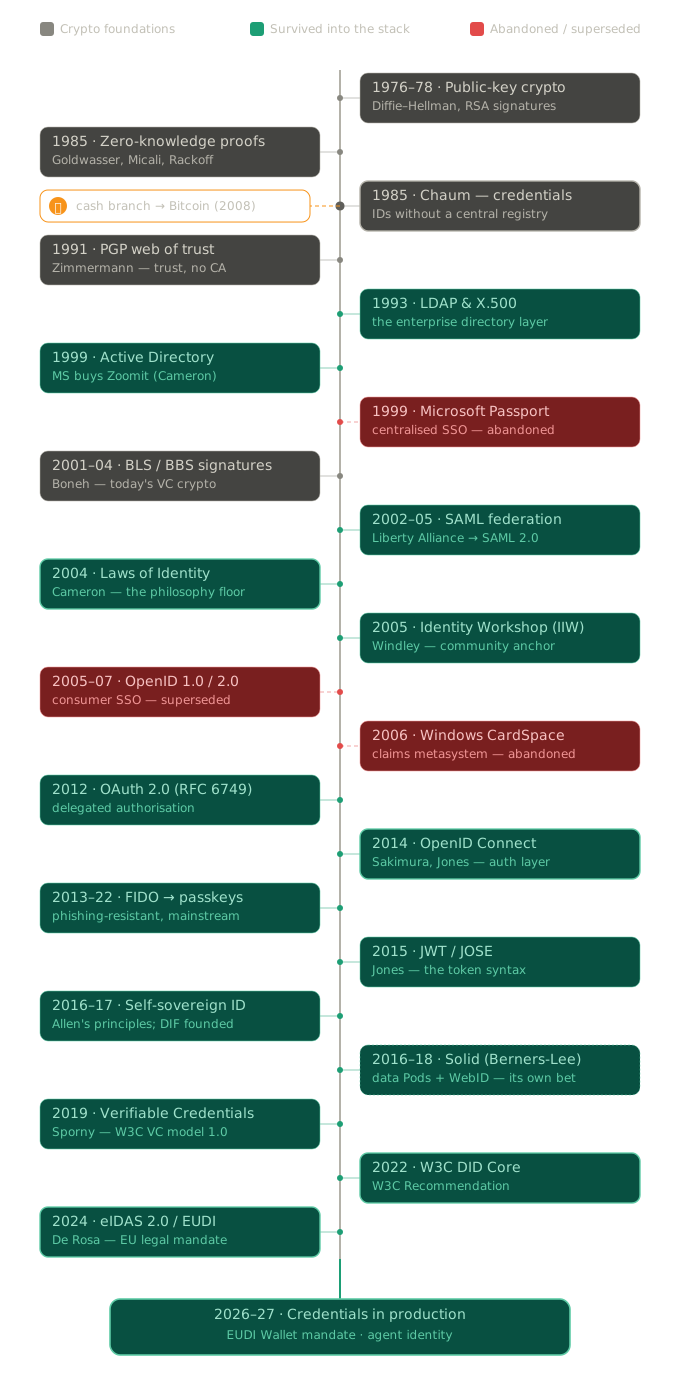
İlk biz değiliz.
Çoğu kimlik sistemi, sıfırdan başladıklarını varsaydıkları için başarısız olur. Tarih başka bir şey söylüyor. Çalışan her güven sistemi, kendinden öncekinden birtakım gelenekler devraldı — Konstantin ağırlık standartlarını Atina'dan, Floransa noterlik sistemini Roma'dan, Stanford asal sayıları Euclid'den devraldı. Solidus, W3C standartlarını, BBS+'ı IBM Research'ten, BFT konsensüsünü Tendermint'ten devralır. Kalıcı bir şey yapacaksak, bunun nedeni zaten işe yarayan şeyin üzerinde durmuş olmamız olacak.
Kaynaklara inin.
Yukarıdaki her kilometre taşı bir makaleye veya kitaba bağlanır. Araştırmanın tüm dizini /research adresinde yer alır.